


If you’ve ever felt like life is just too much you’re not alone. Too much noise, too many opinions, too many things pulling at your attention can affect negatively all aspects of your life. Minimalism isn’t about having less for the sake of it. It is about creating space for what actually matters. When you strip away the excess, the “too much”, what you’re left with is clarity, intention, and a stronger sense of well-being.
Here are 5 ways minimalism supports the shift to better well-being.
1. Minimalism clears mental clutter and supports emotional well-being.
My journey to minimalism didn’t start as a lifestyle choice. It started as survival. When I became a mother at 44, I found myself overwhelmed by a constant flood of noise: opinions, advice, comparison, and negativity. It left me feeling mentally cluttered, disconnected from myself, and honestly, a little lost. That internal chaos began to affect everything – my parenting, my marriage, and how I showed up in my life.
What I came to realize is that minimalism isn’t just about your physical space. It is about your mental space, too. I needed to quiet the noise, get clear on how I wanted to feel, and let go of what wasn’t serving me. What I learned is that when you reduce what is crowding your mind and your environment, you create room to think clearly, process emotions, and move through life with more intention. That shift along can change everything.
2. Minimalism brings financial clarity and reduces stress.
Minimalism naturally changes how you spend. When you focus on keeping only what you truly like, need, and use, it becomes much easier to recognize that you already have enough. That awareness alone can stop the cycle of overbuying.
Instead of purchases things “just in case”, you being to shop with intention. And that deliberateness doesn’t just save money. It saves time, energy, and mental bandwidth. You’re no longer managing excess or digging through clutter to find what you need. Your space feels calmer, and in turn, so do you.
3. Minimalism encourages more conscious, sustainable living.
There is often a deeper reason behind why we accumulate so much. Sometimes it’s fear – of missing out or not having enough. Sometimes it’s emotional and you try to fill a void with stuff instead of looking at what you truly need. When consumption becomes easy and constant, we start to lose sight of the value of what we bring into our lives.
That disconnect doesn’t just affect our homes. It impacts the environment, too. When we buy more, especially without intention, we waste more. Minimalism shifts that pattern. By focusing on enoughness, and making more thoughtful choices, you naturally reduce waste – physically, mentally, and environmentally. It’s a more responsible and grounded way to live.
4. Minimalism shifts your mindset from scarcity to enoughness.
One of the hardest parts about embracing minimalism is the feeling that you’re giving something up. It’s easy to focus on what you’re losing instead of what you’re gaining. But that is where the real mindset shift happens.
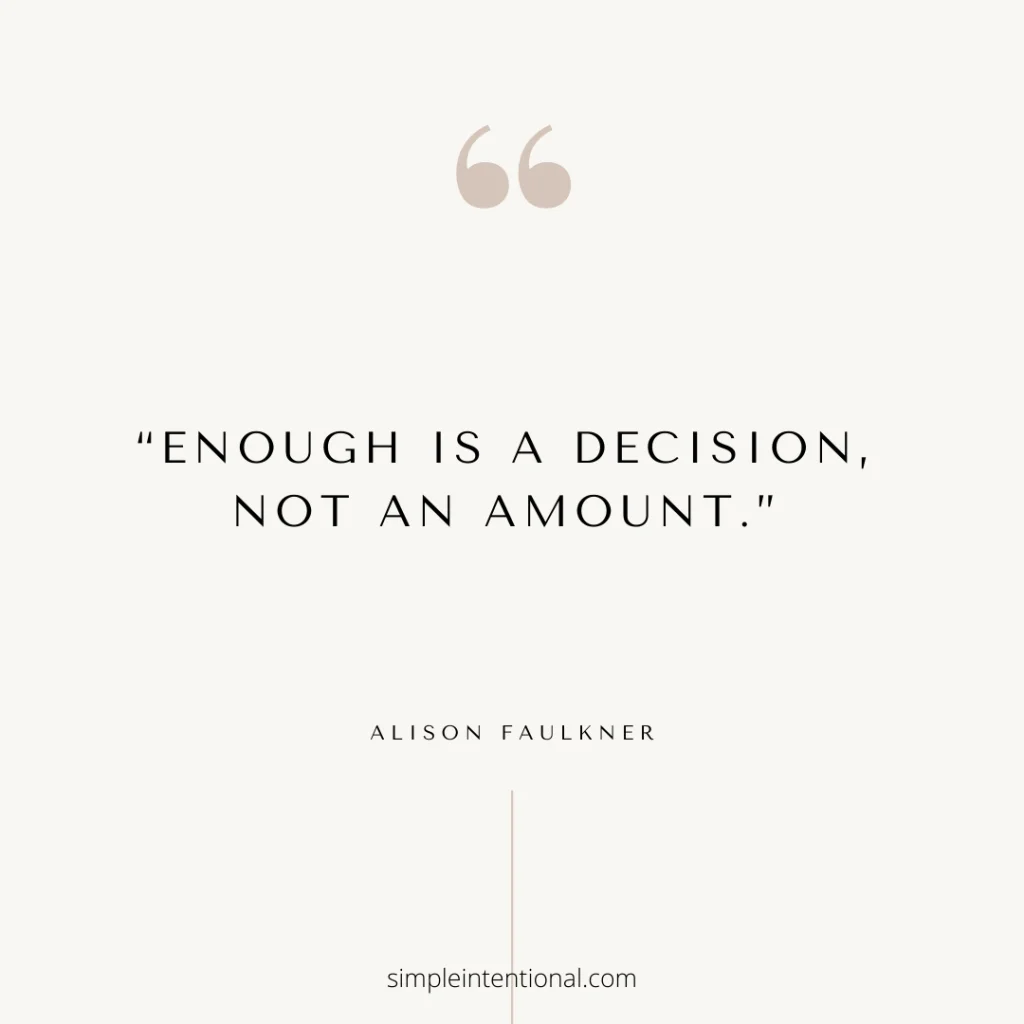
Minimalism teaches you that having less doesn’t mean lacking. It means having enough. And when you truly understand that, everything changes. You start to value clarity over chaos, freedom over excess, and peace of over pressure. This shift in perspective makes the transition feel less restrictive and more empowering.
{If you’d like to learn more about the thought patterns that create clutter, I wrote this article to help you.}
5. Minimalism helps you live more intentionally, one step at a time.
Minimalism isn’t a one-size-fits all approach. It is deeply personal. It’s about deciding what matters most to you and building your life around that. That kind of clarity doesn’t happen all at once, and it doesn’t need to.
The most effective way to start is small. Instead of trying to change everything, focus on one space and ask yourself: How do I want this to feel? And how do I want to feel in this space? From there, you can begin letting go of what doesn’t align with that vision. Small, intentional steps add up. And over time, they create a life that feels lighter, clearer, and more synchronized with who you are.
Minimalism isn’t about perfection or deprivation. It is about creating space to live well. And when you give yourself that space, everything else has room to fall into place.